

- 14 Oct
- 2026
Thesis Mahasiswa NIM 14240002
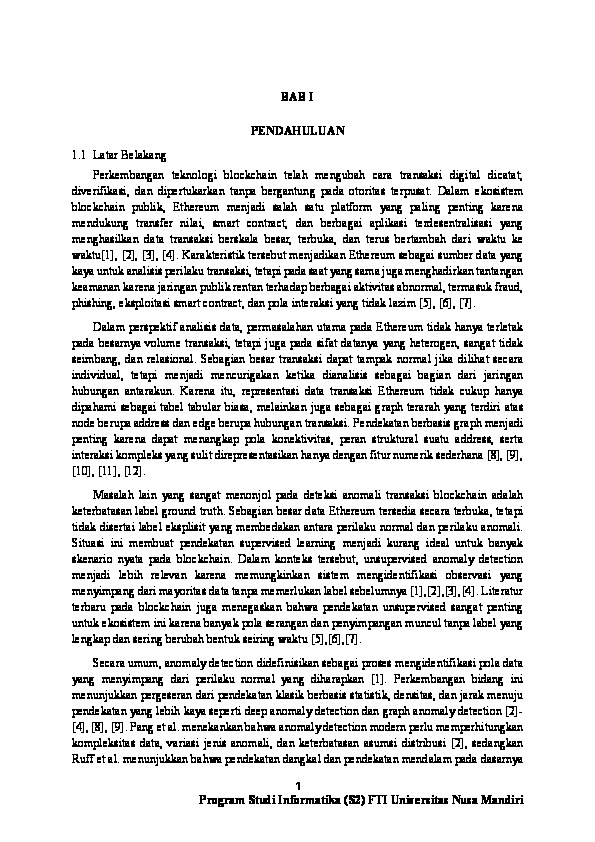
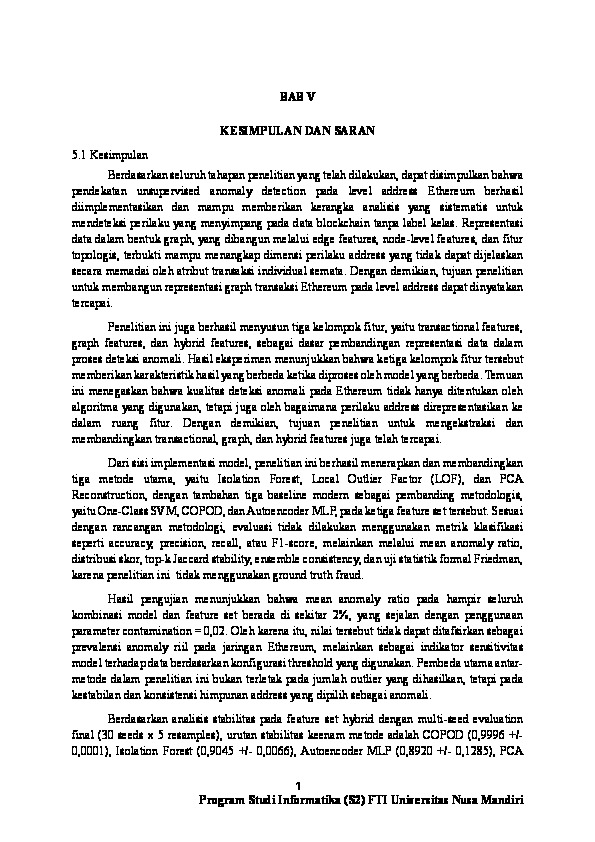
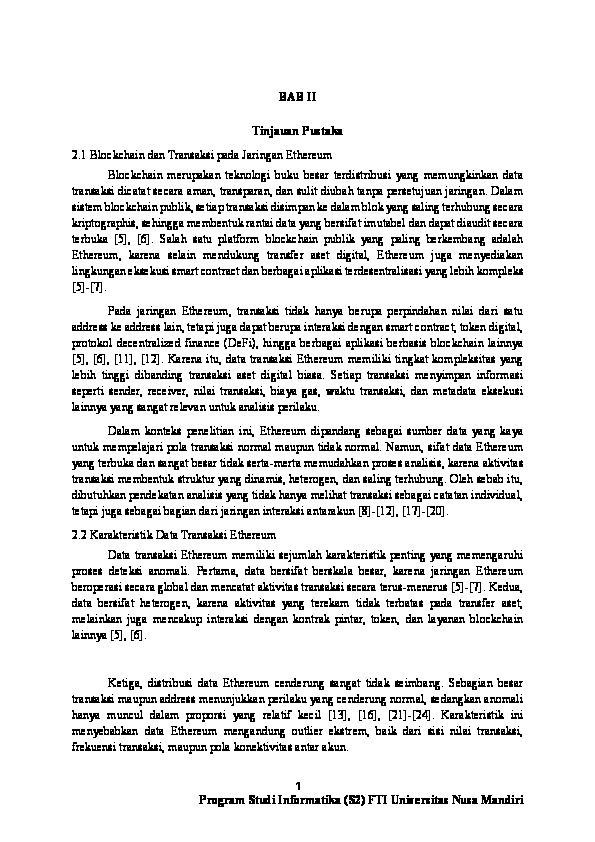
Perkembangan ekosistem blockchain, khususnya Ethereum, telah menghasilkan data transaksi yang sangat besar, heterogen, relasional, dan minim label, sehingga deteksi perilaku abnormal pada jaringan ini menjadi tantangan penting dalam blockchain analytics. Penelitian ini bertujuan membandingkan kinerja Isolation Forest, Local Outlier Factor (LOF), dan PCA-based anomaly detection dalam mendeteksi anomali pada address Ethereum melalui pendekatan unsupervised anomaly detection, serta menguji posisi relatif metode klasik tersebut terhadap tiga baseline modern yaitu One-Class SVM, COPOD, dan Autoencoder berbasis Multi-Layer Perceptron. Data diperoleh dari Google BigQuery Ethereum Public Dataset dan direpresentasikan pada level address melalui pembentukan edge graph, node-level features, dan fitur topologis graph. Fitur penelitian dikelompokkan ke dalam tiga representasi, yaitu transactional features, graph features, dan hybrid features. Tahapan penelitian meliputi pengumpulan data, preprocessing transaksi, pembentukan fitur, seleksi dan transformasi fitur menggunakan SimpleImputer, VarianceThreshold, dan RobustScaler, penerapan enam metode deteksi anomali, serta evaluasi melalui multi-seed stability evaluation dengan 30 random seeds × 5 resampling, top-k Jaccard stability, ensemble consistency, dan uji statistik formal Friedman dengan analisis post-hoc Wilcoxon dan koreksi Bonferroni. Hasil eksperimen pada 3.000.000 transaksi yang menghasilkan 1.000.120 address menunjukkan bahwa ensemble consistency dengan ambang minimal tiga dari enam model (V(x) >= 3) mengidentifikasi 16.551 address (1,65%) anomali pada feature set transactional, 11.049 address (1,10%) pada graph, dan 11.037 address (1,10%) pada hybrid. Pengujian stabilitas top-k Jaccard menggunakan 30 random seeds pada feature set hybrid menghasilkan urutan COPOD (0,9996 +/- 0,0001), Isolation Forest (0,9045 +/- 0,0066), Autoencoder MLP (0,8920 +/- 0,1285), PCA Reconstruction (0,7180 +/- 0,0579), LOF (0,5210 +/- 0,0230), dan One-Class SVM (0,4179 +/- 0,1148). Uji Friedman pada feature set hybrid menghasilkan χ²(5) = 140,2476 dengan p < 0,001 (Kendall's W = 0,935), menegaskan bahwa terdapat perbedaan kinerja antar-model secara statistik formal; hasil signifikan serupa juga diperoleh pada transactional (χ²(5) = 119,7905, p < 0,001, W = 0,799) dan graph (χ²(5) = 130,4952, p < 0,001, W = 0,870). Fitur pembeda utama meliputi activity_span_hours, out_mean_gas_price, out_tx_count, activity_density, dan k_core, yang menggambarkan kombinasi dimensi temporal, ekonomi, volume, dan struktural graph. Penelitian ini menyimpulkan bahwa pendekatan graph-based pada level address efektif untuk mendeteksi perilaku yang sangat tidak biasa pada Ethereum, di mana Isolation Forest tampil sebagai metode klasik yang paling konsisten lintas inisialisasi acak dengan standar deviasi terendah, sementara COPOD muncul sebagai temuan baru yang paling stabil secara absolut sehingga membuka arah eksplorasi metodologis lebih lanjut untuk penelitian selanjutnya.
Unduhan



-

-

-
-

Thesis - 14240002 - Agus Rahmat Fadillah.pdf
Terakhir download 15 Oct 2026 14:10File Tugas Akhir Lengkap
- diunduh 1x | Ukuran 2,329,784
-

Paper_Stability-Based_Comparative_Evaluation.pdf
Terakhir download 15 Oct 2026 14:10FIle Jurnal
- diunduh 2x | Ukuran 827,533
REFERENSI
[1] Pang, G., Shen, C., Cao, L., & van den Hengel, A. (2021). Deep learning for anomaly detection: A review. ACM Computing Surveys, 54(2), Article 38. https://doi.org/10.1145/3439950
[2] Ruff, L., Kauffmann, J. R., Vandermeulen, R. A., Montavon, G., Samek, W., Kloft, M., Dietterich, T. G., & Müller, K.-R. (2021). A unifying review of deep and shallow anomaly detection. Proceedings of the IEEE, 109(5), 756–795. https://doi.org/10.1109/JPROC.2021.3052449
[3] Nassif, A. B., Talib, M. A., Nasir, Q., & Dakalbab, F. M. (2021). Machine learning for anomaly detection: A systematic review. IEEE Access, 9, 78658–78700. https://doi.org/10.1109/ACCESS.2021.3083060
[4] Hassan, M. U., Rehmani, M. H., & Chen, J. (2023). Anomaly detection in blockchain networks: A comprehensive survey. IEEE Communications Surveys & Tutorials, 25(1), 289–318. https://doi.org/10.1109/COMST.2022.3205643
[5] Cholevas, C., Angeli, E., Sereti, Z., Mavrikos, E., & Tsekouras, G. E. (2024). Anomaly detection in blockchain networks using unsupervised learning: A survey. Algorithms, 17(5), Article 201. https://doi.org/10.3390/a17050201
[6] Ma, X., Wu, J., Xue, S., Yang, J., Zhou, C., Sheng, Q. Z., Xiong, H., & Akoglu, L. (2023). A comprehensive survey on graph anomaly detection with deep learning. IEEE Transactions on Knowledge and Data Engineering, 35(12), 12012–12038. https://doi.org/10.1109/TKDE.2021.3118815
[7] Ekle, O. A., & Eberle, W. (2024). Anomaly detection in dynamic graphs: A comprehensive survey. ACM Transactions on Knowledge Discovery from Data, 18(8), Article 192. https://doi.org/10.1145/3669906
[8] Podgorelec, B., Turkanović, M., & Karakatič, S. (2020). A machine learning-based method for automated blockchain transaction signing including personalized anomaly detection. Sensors, 20(1), Article 147. https://doi.org/10.3390/s20010147
[9] Xiong, A., Tong, Y., Jiang, C., & Hu, Z. (2023). Ethereum phishing detection based on graph neural networks. IET Blockchain, 4(3), 226–234. https://doi.org/10.1049/blc2.12031
[10] Chen, Z., Liu, S.-Z., Huang, J., Xiu, Y.-H., Zhang, H., & Long, H.-X. (2024). Ethereum phishing scam detection based on data augmentation method and hybrid graph neural network model. Sensors, 24(12), Article 4022. https://doi.org/10.3390/s24124022
[11] Nakamoto, S. (2008). Bitcoin: A Peer-to-Peer Electronic Cash System. https://bitcoin.org/
[12] Wood, G. (2014). Ethereum: A Secure Decentralised Generalised Transaction Ledger. https://ethereum.github.io/yellowpaper/
[13] Chen, W., Zheng, Z., Cui, J., Ngai, E., Zheng, P., & Zhou, Y. (2018). Detecting Ponzi schemes on Ethereum: Towards healthier blockchain technology. Proceedings of the Web Conference (WWW). https://doi.org/10.1145/3178876.3186046
[14] Bartoletti, M., Carta, S., Cimoli, T., & Saia, R. (2020). Dissecting Ponzi schemes on Ethereum: Identification, analysis, and impact. Future Generation Computer Systems, 102, 259–277. https://doi.org/10.1016/J.FUTURE.2019.08.014
[15] P. Ostapowicz and K. Żbikowski. (2019). “Detecting fraudulent accounts on Ethereum using supervised learning,” IEEE Access, vol. 7, pp. 150044–150057. https://doi.org/10.1109/ICTEST60614.2024.10576142
[16] Weber, M., Domeniconi, G., Chen, J., Weidele, D. K. I., Bellei, C., Robinson, T., & Leiserson, C. E. (2019). Anti-money laundering in Bitcoin: Experimenting with graph convolutional networks for financial forensics. arXiv preprint arXiv:1908.02591.
[17] Chandola, V., Banerjee, A., & Kumar, V. (2009). Anomaly detection: A survey. ACM Computing Surveys, 41(3), 15. https://doi.org/10.1145/1541880.1541882
[18] M. Gupta, J. Gao, C. C. Aggarwal, and J. Han. (2014). “Outlier detection for temporal data: A survey,” IEEE Transactions on Knowledge and Data Engineering, vol. 26, no. 9, pp. 2250–2267. https://doi.org/10.1109/TKDE.2013.184
[19] F. T. Liu, K. M. Ting, and Z.-H. Zhou. (2018). “Isolation Forest,” in Proceedings of the IEEE International Conference on Data Mining, pp. 413–422. https://doi.org/10.1109/ICDM.2008.17
[20] M. M. Breunig, H.-P. Kriegel, R. T. Ng, and J. Sander. (2000). “LOF: Identifying density-based local outliers,” in Proceedings of the ACM SIGMOD International Conference on Management of Data, pp. 93–104. https://doi.org/10.1145/335191.335388
[21] T. Pham and S. Lee. (2016). “Anomaly detection in Bitcoin network using unsupervised learning methods,” in Proceedings of the IEEE International Conference on Data Mining Workshops, pp. 617–624. https://doi.org/10.48550/arXiv.1611.03941
[22] P. Monamo, V. Marivate, and B. Twala. (2016). “Unsupervised learning for robust Bitcoin fraud detection,” in Proceedings of the Information Security for South Africa Conference. https://doi.org/10.1109/ISSA.2016.7802939
[23] M. Goldstein and S. Uchida. (2016) “A comparative evaluation of unsupervised anomaly detection algorithms for multivariate data,” PLoS ONE, vol. 11, no. 4. https://doi.org/10.1371/journal.pone.0152173
[24] G. O. Campos, A. Zimek, J. Sander, R. J. G. B. Campello, B. Micenková, E. Schubert, I. Assent, and M. E. Houle. (2016). “On the evaluation of unsupervised outlier detection: Measures, datasets, and an empirical study,” Data Mining and Knowledge Discovery, vol. 30, pp. 891–927. https://doi.org/10.1007/s10618-015-0444-8
[25] L. Akoglu, H. Tong, and D. Koutra. (2015). “Graph based anomaly detection and description: A survey,” Data Mining and Knowledge Discovery, vol. 29, pp. 626–688. https://doi.org/10.48550/arXiv.1404.4679
[26] G. Pang, C. Shen, L. Cao, and A. van den Hengel. (2021). “Deep learning for anomaly detection: A review,” ACM Computing Surveys, vol. 54, no. 2. https://doi.org/10.1145/3439950
[27] M. Ahmed, A. N. Mahmood, and J. Hu. (2016). “A survey of network anomaly detection techniques” Journal of Network and Computer Applications, vol. 60, pp. 19–31. https://doi.org/10.1016/j.jnca.2015.11.016
[28] Hasan, M., Rahman, M. S., Janicke, H., & Sarker, I. H. (2024). Detecting anomalies in blockchain transactions using machine learning classifiers and explainability analysis. Blockchain: Research and Applications, 5(3), 100207. https://doi.org/10.1016/j.bcra.2024.100207
[29] Patel, V., Pan, L., & Rajasegarar, S. (2020). Graph deep learning based anomaly detection in Ethereum blockchain network. In Network and System Security (pp. 132–148). Springer. https://doi.org/10.1007/978-3-030-65745-1_8
[30] Sui, H., Zhang, J., Chen, B., Wu, D., Sun, X., & Palaiahnakote, S. (2025). EPAD: Ethereum phishing scam detection via graph contrastive learning. Expert Systems with Applications, 288, 128227. https://doi.org/10.1016/j.eswa.2025.128227
[31] Wang, L., Mi, Y., Zhang, Y., & Zhang, J. (2026). PDHG: An Ethereum phishing detection approach via heterogeneous graph transformer. Expert Systems with Applications, 298, 129919. https://doi.org/10.1016/j.eswa.2025.129919
[32] Chang, Z., Cai, Y., Liu, X. F., Xie, Z., Liu, Y., & Zhan, Q. (2025). Anomalous node detection in blockchain networks based on graph neural networks. Sensors, 25(1), 1. https://doi.org/10.3390/s2501000
[33] Shevchuk, R., Martsenyuk, V., Adamyk, B., Benson, V., & Melnyk, A. (2025). Anomaly detection in blockchain: A systematic review of trends, challenges, and future directions. Applied Sciences, 15(15), 8330. https://doi.org/10.3390/app15158330
[34] Jumani, F., & Raza, M. (2025). Machine learning for anomaly detection in blockchain: A critical analysis, empirical validation, and future outlook. Computers, 14(7), 247. https://doi.org/10.3390/computers14070247
[35] Kamran, M., Rehan, M. M., Nisar, W., & Rehan, M. W. (2024). AHEAD: A novel technique combining anti-adversarial hierarchical ensemble learning with multi-layer multi-anomaly detection for blockchain systems. Big Data and Cognitive Computing, 8(9), 103. https://doi.org/10.3390/bdcc8090103
[36] Mašková, M., Zorek, M., Pevný, T., & Šmídl, V. (2024). Deep anomaly detection on set data: Survey and comparison. Pattern Recognition, 151, 110381. https://doi.org/10.1016/j.patcog.2024.11038
[37] Adhikari, D., Jiang, W., Zhan, J., Rawat, D. B., & Bhattarai, A. (2024). Recent advances in anomaly detection in Internet of Things: Status, challenges, and perspectives. Computer Science Review, 54, 100665. https://doi.org/10.1016/j.cosrev.2024.100665
[38] Ren, J., Xia, F., Lee, I., Hoshyar, A. N., & Aggarwal, C. C. (2023). Graph learning for anomaly analytics: Algorithms, applications, and challenges. ACM Transactions on Intelligent Systems and Technology, 14(2), Article 28. https://doi.org/10.1145/3570906
[39] Sghaier, R., El Hog, C., Ben Djemaa, R., & Sliman, L. (2025). Machine learning and blockchain synergy: Opportunities and challenges for ML models and smart contracts. Blockchain: Research and Applications, 100411. https://doi.org/10.1016/j.bcra.2025.100411
[40] Ashfaq, T., Khalid, R., Yahaya, A. S., Aslam, S., Azar, A. T., Alsafari, S., & Hameed, I. A. (2022). A machine learning and blockchain based efficient fraud detection mechanism. Sensors, 22(19), 7162. https://doi.org/10.3390/s22197162
[41] Chen, H., Pendleton, M., Njilla, L., & Xu, S. (2020). A survey on Ethereum systems security: Vulnerabilities, attacks, and defenses. ACM Computing Surveys, 53(3), Article 67. https://doi.org/10.1145/3391195
[42] Wang, L., Mi, Y., Zhang, Y., & Zhang, J. (2026). PDHG: An Ethereum phishing detection approach via heterogeneous graph transformer. Expert Systems with Applications, 298, 129919. https://doi.org/10.1016/j.eswa.2025.129919
[43] Wang, Z., Jin, H., Dai, W., Choo, K.-K. R., & Zou, D. (2021). Ethereum smart contract security research: Survey and future research opportunities. Frontiers of Computer Science, 15(2), 152802. https://doi.org/10.1007/s11704-020-9284-9
[44] Jain, V. K., & Tripathi, M. (2026). Ethereum smart contract security: Vulnerabilities, analysis techniques, challenges and research directions. Computers & Electrical Engineering, 130, 110895. https://doi.org/10.1016/j.compeleceng.2025.110895
[45] Jiao, T., Xu, Z., Qi, M., Wen, S., Xiang, Y., & Nan, G. (2024). A survey of Ethereum smart contract security: Attacks and detection. Distributed Ledger Technologies: Research and Practice, 3(3). https://doi.org/10.1145/3643895
[46] Chu, H., Zhang, P., Dong, H., Xiao, Y., Ji, S., & Li, W. (2023). A survey on smart contract vulnerabilities: Data sources, detection and repair. Information and Software Technology, 159, 107221. https://doi.org/10.1016/j.infsof.2023.107221
[47] Bai, X., Liu, D., & Wei, S. (2024). Research on active network topology perception and analysis for Ethereum. Journal of Cyber Security, 9(4), 95–106. https://doi.org/10.19363/J.cnki.cn10-1380/tn.2024.07.06
[48] Liu, J., Chen, J., Wu, J., Wu, Z., Fang, J., & Zheng, Z. (2024). Fishing for fraudsters: Uncovering Ethereum phishing gangs with blockchain data. IEEE Transactions on Information Forensics and Security, 19, 3038–3050. https://doi.org/10.1109/TIFS.2024.3359000
[49] El-Attar, N. E., Salama, M. H., Abdelfattah, M., & Taha, S. (2025). An optimized framework for detecting suspicious accounts in the Ethereum blockchain network. Cryptography, 9(4). https://doi.org/10.3390/cryptography9040063
[50] Gu, Z., & Dib, O. (2025). Enhancing fraud detection in the Ethereum blockchain using ensemble learning. PeerJ Computer Science, 11. https://doi.org/10.7717/PEERJ-CS.2716
[51] Latif, M. N., Kaplan, M., & Khan, A. U. I. (2025). Unsupervised machine learning based anomaly detection in high frequency data: Evidence from cryptocurrency market. Pakistan Journal of Commerce and Social Sciences, 19(3), 407–440. https://doi.org/10.64534/Commer.2025.511
[52] Z. Li, Y. Zhao, N. Botta, C. Ionescu and X. Hu, "COPOD: Copula-Based Outlier Detection," 2020 IEEE International Conference on Data Mining (ICDM), Sorrento, Italy, 2020, pp. 1118-1123, doi: 10.1109/ICDM50108.2020.00135.
Kiriman Terbaru
-
15 Oct 2026
-

15 Oct 2026
-
15 Oct 2026
-

15 Oct 2026
-
15 Oct 2026