
- 10 Mar
- 2026
Tugas Akhir Mahasiswa NIM 11240297
ABSTRAK
Dinata Ayu Suriana (11240297) Analisis Penerimaan Sistem ERP Berbasis Odoo Menggunakan Pendekatan TAM dan Hot-Fit di Perusahaan Konveksi Queena Cloth
Penerapan sistem Enterprise Resource Planning (ERP) pada Usaha Mikro, Kecil, dan Menengah (UMKM) sektor konveksi menjadi kebutuhan strategis untuk meningkatkan efisiensi operasional dan integrasi proses bisnis. Queena Cloth sebagai perusahaan konveksi di Tangerang Selatan mengimplementasikan sistem ERP Odoo untuk mengatasi permasalahan ketidakterpaduan data produksi, persediaan, dan administrasi karyawan. Namun, keberhasilan implementasi sistem tidak hanya ditentukan oleh aspek teknis, melainkan juga oleh tingkat penerimaan pengguna. Penelitian ini bertujuan untuk menganalisis faktor-faktor yang memengaruhi penerimaan sistem ERP Odoo di Queena Cloth menggunakan model hybrid Technology Acceptance Model (TAM) dan Human–Organization–Technology Fit (HOT-Fit). Penelitian ini menggunakan pendekatan kuantitatif dengan metode survei melalui kuesioner berskala Likert. Teknik pengambilan sampel yang digunakan adalah sampling jenuh dengan jumlah responden sebanyak 37 karyawan yang secara langsung menggunakan sistem ERP Odoo. Data dianalisis menggunakan regresi linear berganda dengan bantuan perangkat lunak SPSS 26. Pengujian meliputi uji validitas, reliabilitas, asumsi klasik, serta uji hipotesis simultan dan parsial. Hasil penelitian menunjukkan bahwa secara simultan, dimensi teknologi, manusia, dan organisasi berpengaruh signifikan terhadap penerimaan sistem ERP Odoo dengan nilai koefisien determinasi sebesar 96,9%. Secara parsial, variabel Persepsi Kegunaan, Persepsi Kemudahan Penggunaan, dan Dukungan Organisasi berpengaruh signifikan terhadap penerimaan sistem. Dukungan Organisasi menjadi faktor paling dominan, sementara dimensi teknologi tidak menunjukkan pengaruh signifikan dan cenderung berperan sebagai hygiene factor dalam konteks penggunaan sistem yang bersifat mandatory. Temuan ini menegaskan pentingnya peran manajerial dan persepsi manfaat dalam keberhasilan implementasi ERP pada lingkungan UMKM.
Kata kunci: ERP Odoo, TAM, HOT-Fit, Penerimaan Sistem, UMKM
ABSTRACT
Dinata Ayu Suriana (11240297) Analysis of ERP System Acceptance Based on Odoo Using the TAM and HOT-Fit Approaches at Queena Cloth Convection Company
The implementation of Enterprise Resource Planning (ERP) systems in Micro, Small, and Medium Enterprises (MSMEs) within the convection industry has become a strategic necessity to enhance operational efficiency and business process integration. Queena Cloth, a convection company located in South Tangerang, has implemented the Odoo ERP system to address issues related to the lack of integration in production data, inventory management, and employee administration. However, the success of ERP implementation is not solely determined by technical aspects, but also by the level of user acceptance. This study aims to analyze the factors influencing the acceptance of the Odoo ERP system at Queena Cloth by employing a hybrid model that integrates the Technology Acceptance Model (TAM) and the Human–Organization–Technology Fit (HOT-Fit) framework. A quantitative approach was adopted using a survey method with Likert-scale questionnaires. The sampling technique employed was saturated sampling, involving 37 employees who directly use the Odoo ERP system in their daily operations. Data analysis was conducted using multiple linear regression with the assistance of SPSS version 26. The analysis included validity and reliability testing, classical assumption tests, as well as simultaneous and partial hypothesis testing. The results indicate that, simultaneously, the technology, human, and organizational dimensions have a significant effect on the acceptance of the Odoo ERP system, with a coefficient of determination of 96.9%. Partially, Perceived Usefulness, Perceived Ease of Use, and Organizational Support were found to have a significant influence on system acceptance. Organizational Support emerged as the most dominant factor, while the technology dimension did not show a significant effect and tended to function as a hygiene factor within the context of mandatory system usage. These findings emphasize the critical role of managerial support and perceived benefits in ensuring the successful implementation of ERP systems in MSME environments.
Keywords: Odoo ERP, TAM, HOT-Fit, System Acceptance, Convection MSMEs
Unduhan
-
Tugas Akhir_Dinata Ayu Suriana_11240297-Lampiran Awal.pdf
Terakhir download 16 Sep 2026 17:09Lampiran Awal
- diunduh 80x | Ukuran 760 KB
-
Tugas Akhir_Dinata Ayu Suriana_11240297-Cover.pdf
Terakhir download 15 Sep 2026 15:09Cover
- diunduh 60x | Ukuran 139 KB
-
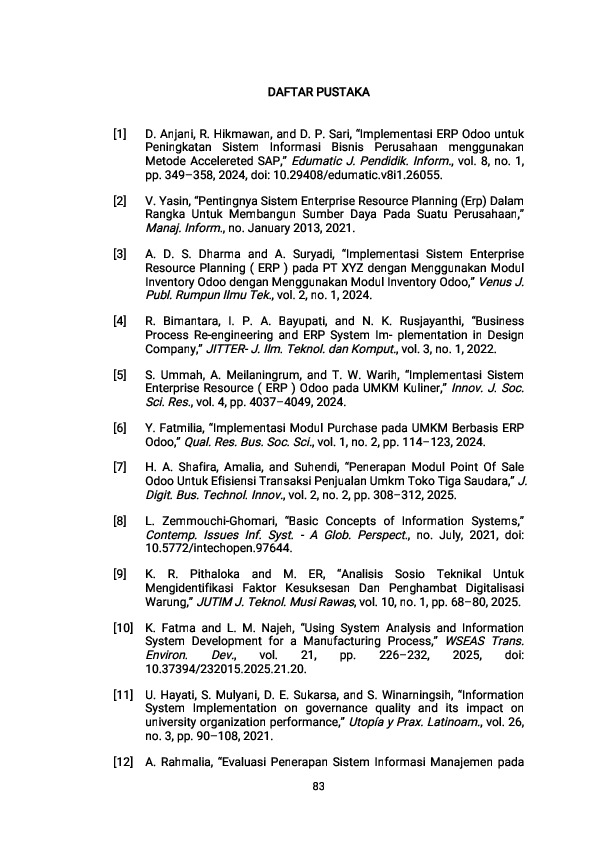
Tugas Akhir_Dinata Ayu Suriana_11240297-Daftar Pustaka.pdf
Terakhir download 17 Sep 2026 13:09Daftar Pustaka
- diunduh 237x | Ukuran 237 KB
-
Tugas Akhir_Dinata Ayu Suriana_11240297-Bab 2.pdf
Terakhir download 19 Sep 2026 07:09Bab 2 - Landasan Teori
- diunduh 107x | Ukuran 630 KB
-
Tugas Akhir_Dinata Ayu Suriana_11240297-Bab 4.pdf
Terakhir download 15 Sep 2026 15:09Bab 4 - Hasil Penelitian dan Pembahasan
- diunduh 55x | Ukuran 734 KB
-
Tugas Akhir_Dinata Ayu Suriana_11240297-Bab 3.pdf
Terakhir download 15 Sep 2026 15:09Bab 3 - Metodologi Penelitian
- diunduh 59x | Ukuran 485 KB
-
Tugas Akhir_Dinata Ayu Suriana_11240297-Bab 3.pdf
Terakhir download 15 Sep 2026 15:09Bab 3 - Metodologi Penelitian
- diunduh 59x | Ukuran 496,677
-
Tugas Akhir_Dinata Ayu Suriana_11240297-Bab 1.pdf
Terakhir download 17 Sep 2026 15:09Bab 1 - Pendahuluan
- diunduh 62x | Ukuran 305,637
-
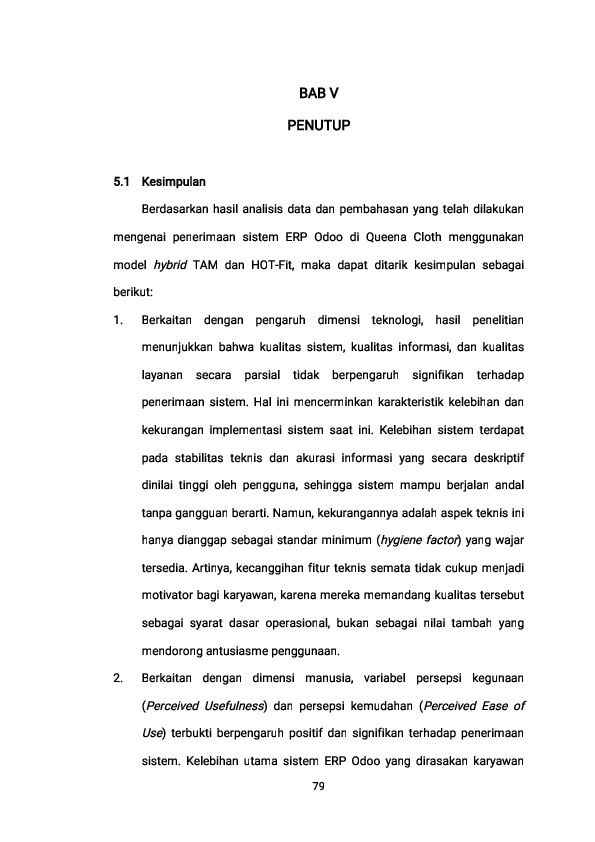
Tugas Akhir_Dinata Ayu Suriana_11240297-Bab 5.pdf
Terakhir download 15 Sep 2026 14:09Bab 5 - Penutup
- diunduh 45x | Ukuran 288,454
-
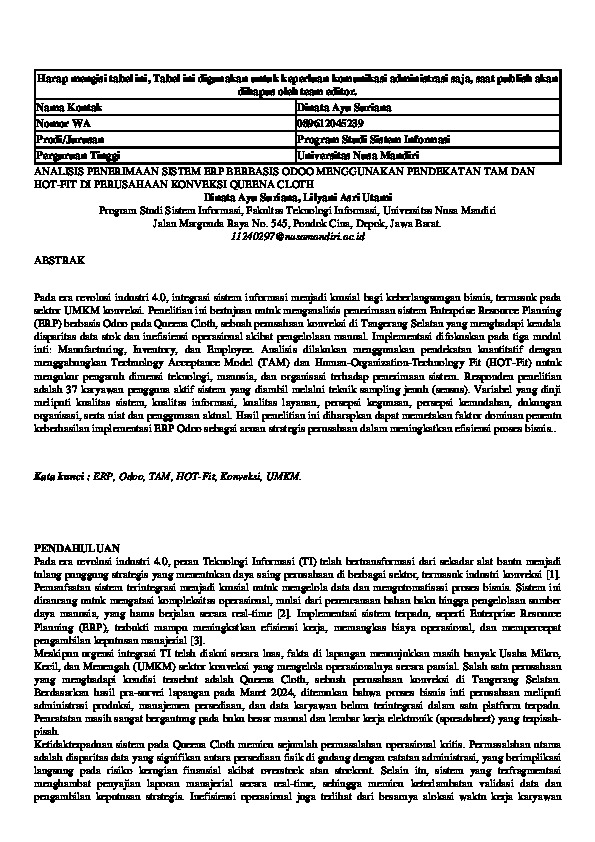
Jurnal_Dinata Ayu Suriana_11240297.pdf
Terakhir download 16 Sep 2026 03:09Jurnal
- diunduh 187x | Ukuran 412,356
-
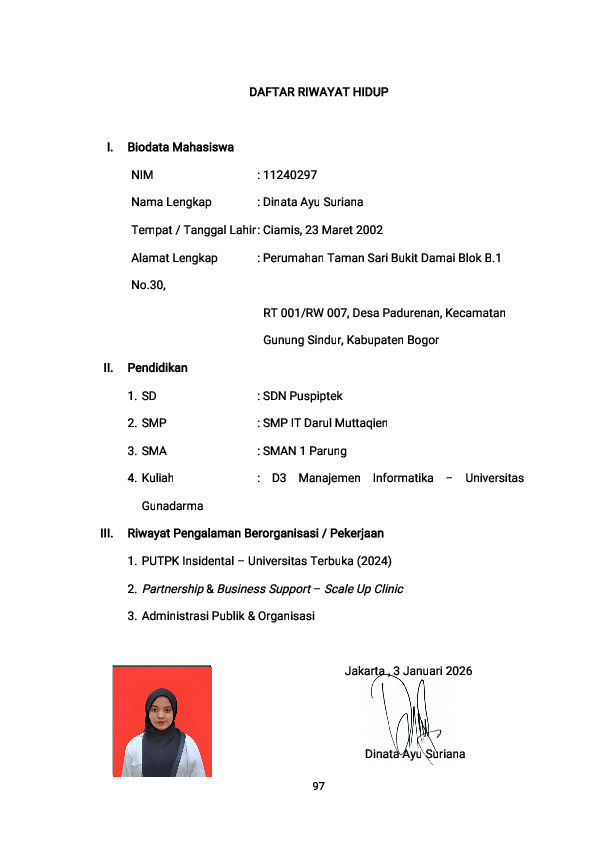
Tugas Akhir_Dinata Ayu Suriana_11240297-Lampiran Akhir.pdf
Terakhir download 16 Sep 2026 13:09Lampiran Akhir
- diunduh 76x | Ukuran 1,791,792
-

Tugas Akhir_Dinata Ayu Suriana_11240297.pdf
Terakhir download 17 Sep 2026 14:09Tugas Akhir Full Paper
- diunduh 175x | Ukuran 2,451,109
REFERENSI
DAFTAR PUSTAKA
Kiriman Terbaru
-

18 Sep 2026
-
18 Sep 2026
-
18 Sep 2026
-
17 Sep 2026
-
14 Sep 2026