

- 21 Oct
- 2025
File Tugas Akhir Periode 1 2025
Setiap harinya, terdapat ribuan artikel berita dipublikasikan oleh berbagai portal berita nasional, yang masing-masing memiliki gaya bahasa, pendekatan jurnalistik, serta framing (pembingkaian informasi) yang beragam. Pendekatan manual yang dilakukan untuk membaca dan mengkaji ribuan berita tentu memerlukan waktu, tenaga dan sumber daya yang besar. Realitas tersebut menimbulkan kebutuhan terhadap pendekatan otomatis yang mampu mengidentifikasi dan mengklasifikasikan sentimen secara cepat dan akurat, yang tidak hanya berguna untuk mendeteksi kecenderungan opini publik, tetapi juga membantu dalam mengidentifikasi potensi bias atau kecenderungan opini publik terhadap isu tertentu. Penelitian ini menggunakan pendekatan kuantitatif dengan metode eksperimen untuk menguji secara sistematis performa model klasifikasi sentimen pada berita digital. Dengan memanfaatkan teknologi kecerdasan buatan, khususnya Natural Language Processing (NLP), penelitian ini menerapkan model IndoBERTa yang telah melalui proses fine-tuning untuk melakukan klasifikasi sentimen pada berita digital dengan mengacu pada kerangka kerja CRISP-DM yang terdiri dari enam tahapan. Berdasarkan hasil evaluasi, model menunjukkan performa tinggi dengan Accuracy dan Cohen’s Kappa sebesar 98%, yang berarti bahwa distribusi dari klasifikasi sentimen menunjukkan bahwa model mampu menangkap konteks topik berita. Berdasarkan hal tersebut, untuk mendukung penerapannya, model ini diintegrasikan ke dalam pipeline berbasis Streamlit yang mengotomatisasi proses mulai dari pengumpulan berita, klasifikasi sentimen, hingga visualisasi dan ekspor hasil analisis.
Kata Kunci: Berita Digital, Analisis Sentimen, NLP, IndoBERTa, Fine-Tuning
Unduhan
-
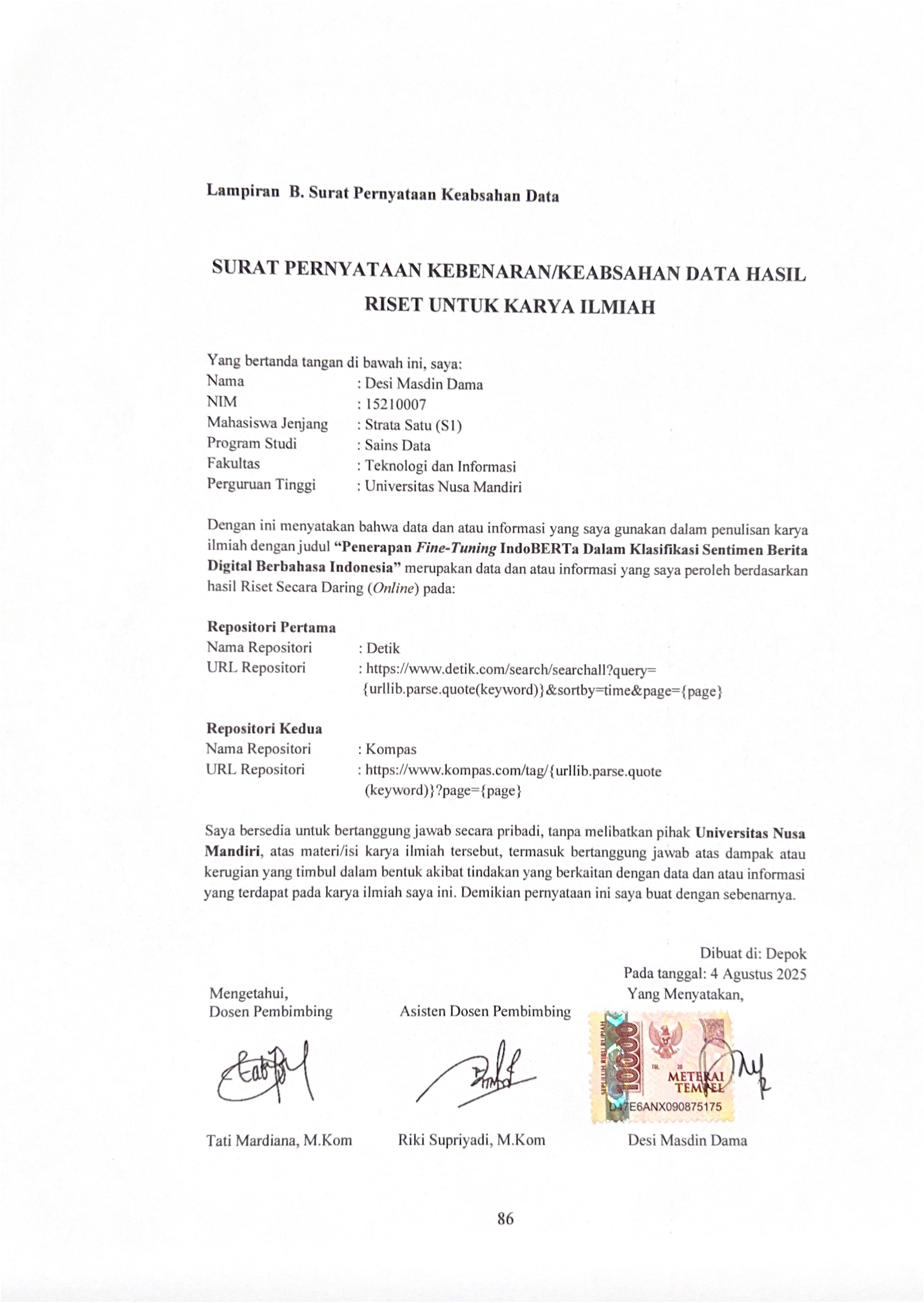
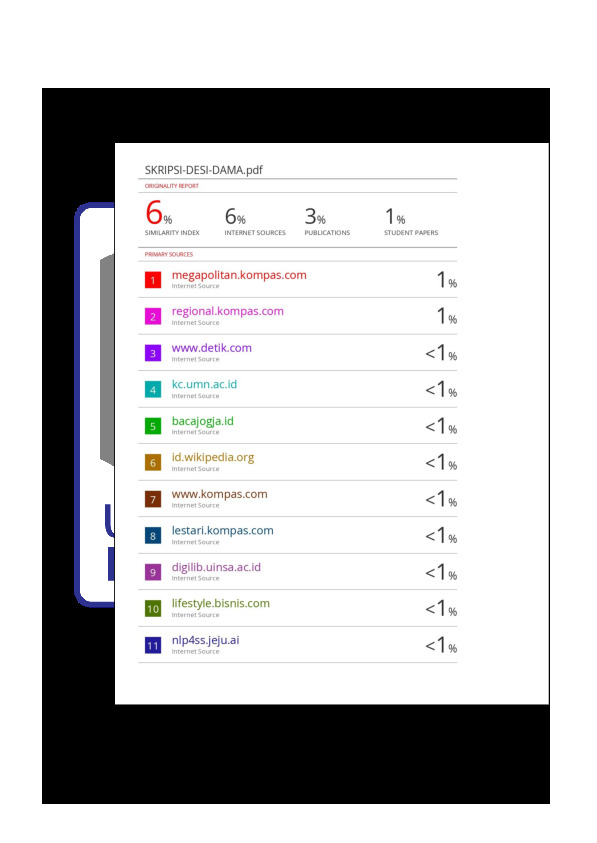
File 7_Doc Pendukung Lainnya.pdf
Terakhir download 10 Oct 2026 10:10File 7_Keabsahan Data, bukti plagiat, bukti submit jurnal dan link submit
- diunduh 96x | Ukuran 2,079 KB
-
FULL TUGAS AKHIR DESI DAMA FIX.pdf
Terakhir download 05 Jan 2026 17:01FULL TUGAS AKHIR
- diunduh 1x | Ukuran 6,604 KB
-

-

-

-
-

-

-

FIle 1_Cover dan Surat Pernyataan.pdf
Terakhir download 07 Oct 2026 14:10File 1_Cover dan Surat Pernyataan
- diunduh 166x | Ukuran 5,549,183
-

FIX Journal Desi-update1410.pdf
Terakhir download 10 Oct 2026 20:10File 8_ Draft Journal
- diunduh 237x | Ukuran 648,495
REFERENSI
[1] S. Kemp, “Digital 2024: Global Overview Report,” Data Reportal. Accessed: Jun. 03, 2025. [Online]. Available: https://datareportal.com/reports/digital-2024-global-overview-report
[2] R. Chandra, B. Zhu, Q. Fang, and E. Shinjikashvili, “Large language models for sentiment analysis of newspaper articles during COVID-19: The Guardian,” Applied Soft Computing Journal, vol. 171, Jan. 2025, doi: 10.1016/j.asoc.2025.112743.
[3] M. Alam, A. Iana, A. Grote, K. Ludwig, P. Müller, and H. Paulheim, “Towards Analyzing the Bias of News Recommender Systems Using Sentiment and Stance Detection,” WWW 2022 - Companion Proceedings of the Web Conference 2022, pp. 448–457, Mar. 2022, doi: 10.1145/3487553.3524674.
[4] Zulham, F. A. Lubis, D. Priyono, Fauzan, S. Julina, and D. A. Deryansyah, “Framing Media dalam Berita Kontroversial: Studi Kasus pada Kasus-Kasus Politik atau Sosial,” Jurnal Review Pendidikan dan Pengajaran, vol. 7, no. 3, 2024, Accessed: May 06, 2025. [Online]. Available: http://journal.universitaspahlawan.ac.id/index.php/jrpp
[5] A. R. Hanum et al., “Analisis Kinerja Algoritma Klasifikasi Teks BERT dalam Mendeteksi Berita Hoaks,” Jurnal Teknologi Informasi dan Ilmu Komputer, vol. 11, no. 36, pp. 537–546, Jun. 2024, doi: 10.25126/jtiik938093.
[6] K. Kirtac and G. Germano, “Sentiment trading with large language models,” Financ Res Lett, vol. 62, Mar. 2024, doi: 10.1016/j.frl.2024.105227.
[7] Syahrudin, F. A. Artanto, A. R. Maulana, and Filsafat, “Metode Support Vector Machine (SVM) dan Lexicon-Based dalam Analisis Sentiment Ulasan Pengguna Aplikasi Wink,” JUMINTAL: Jurnal Manajemen Informatika dan Bisnis Digital, vol. 4, no. 1, pp. 59–73, May 2025, doi: 10.55123/jumintal.v4i1.5236.
[8] F. J. Rodrigo-Ginés, J. Carrillo-de-Albornoz, and L. Plaza, “A systematic review on media bias detection: What is media bias, how it is expressed, and how to detect it,” Expert Syst Appl, vol. 237, 2024, doi: 10.1016/j.eswa.2023.121641.
[9] A. Mahendra and S. Styawati, “Implementasi Lowk-Rank Adaptation of Large Langauage Model (LoRA) Untuk Effisiensi Large Language Model,” JIPI (Jurnal Ilmiah Penelitian dan Pembelajaran Informatika), vol. 9, no. 4, pp. 1881–1890, Nov. 2024, doi: 10.29100/jipi.v9i4.5519.
[10] M. E. Syahputra, A. Putera Kemala, and D. Ramdhan, “Clickbait Detection in Indonesia Headline News Using Indobert and Roberta,” JURNAL RISET INFORMATIKA, vol. 5, no. 3, Jun. 2023, doi: 10.34288/jri.v5i3.237.
[11] C. H. Lin and U. Nuha, “Sentiment analysis of Indonesian datasets based on a hybrid deep-learning strategy,” J Big Data, vol. 10, no. 1, Dec. 2023, doi: 10.1186/s40537-023-00782-9.
[12] D. Dwi Saputra, R. Fahlapi, A. Yadi Kuntoro, and T. Asra, “Analisis Sentimen Terhadap Twitter Direktorat Jenderal Bea dan Cukai Menggunakan komparasi Algoritma Naïve Bayes dan Support Vector Machine,” J-INTECH (Journal of Information and Technology), pp. 285–296, 2024.
[13] A. S. Aribowo and S. Khomsah, “Implementation Of Text Mining For Emotion Detection Using The Lexicon Method (Case Study: Tweets About Covid-19) Implementasi Text Mining Untuk Deteksi Emosi Menggunakan Metode Leksikon (Studi Kasus: Twit Tentang Covid-19),” Jurnal Informatika dan Teknologi Informasi, vol. 18, no. 1, pp. 49–60, Feb. 2021, doi: 10.31515/telematika.v18i1.4341.
[14] S. H. Caryarini, F. Adibha, M. K. Luthfi, A. R. Arfianti, and P. K. Nisa, “Konglomerasi Media (Koran Kompas) ke Berita Digital Terhadap Masyarakat,” Jurnal Ilmiah Research and Development Student, vol. 2, no. 2, pp. 103–116, May 2024, doi: 10.59024/jis.v2i2.757.
[15] G. J. Wiladi and M. D. Afrianti, “Pengaruh Literasi Media Digital Terhadap Tindakan Penyebaran Berita Palsu Pada Mahasiswa Universitas Bhayangkara,” Jurnal Ilmiah Wahana Pendidikan, vol. 10, no. 21, pp. 352–360, Nov. 2024, doi: 10.5281/zenodo.14405369.
[16] J. Lantowa and R. Idul, “Representasi Aksi Sosial dalam Konstruksi Ideologi Media Berita Digital Terkait Kebijakan Pemerintah Selama Pandemi,” Ranah: Jurnal Kajian Bahasa, vol. 12, no. 1, pp. 87–100, Jun. 2023, doi: 10.26499/rnh.v12i1.5269.
[17] O. Mailani, I. Nuraeni, S. A. Syakila, and J. Lazuardi, “Bahasa Sebagai Alat Komunikasi Dalam Kehidupan Manusia,” KAMPRET Journal, vol. 1, no. 2, pp. 1–10, Jan. 2022, [Online]. Available: www.plus62.isha.or.id/index.php/kampret
[18] Y. Salim and M. Hasnawi, “Konversi Bahasa Indonesia ke Perintah Data Manipulation Language pada Structured Query Language menggunakan Natural Language Processing,” Buletin Sistem Informasi dan Teknologi Islam, vol. 3, no. 3, pp. 181–187, Aug. 2022, Accessed: May 22, 2025. [Online]. Available: https://garuda.kemdikbud.go.id/documents/detail/3106930
[19] I. Goodfellow, Y. Bengio, and A. Courville, Deep Learning, B. MIT Press, 2016.
[20] R. Danar, D. M. Kom, M. M. Kom, A. Bahtiar, M. Kom, and I. Ali, Dasar Dasar Natural Language Processing (NLP), 1st ed. Minhaj Pustaka, 2024.
[21] F. H. Rachman, Komputasi Bahasa Alami. Malang: Media Nusa Creative (MNC Publishing), 2020. Accessed: May 22, 2025. [Online]. Available: https://play.google.com/store/books/details?id=Gn5JEAAAQBAJ&rdid=book-Gn5JEAAAQBAJ&rdot=1
[22] R. Aulianita, A. M. B. Aji, and Y. E. Achyani, “TEXT MINING MENGGUNAKAN NAIVE BAYES BERBASIS PARTICLE SWARM OPTIMIZATION UNTUK SENTIMENT RESTAURANT,” Jurnal Teknik Informatika Musirawas) Rizki Aulianita, vol. 6, no. 1, pp. 21–29, Jun. 2021, doi: 10.32767/jutim.v6i1.1300.
[23] M. S. ’Afif, M. Muzakir, and Moh. I. A. G. Al Awalaien, “TEXT MINING UNTUK MENGKLASIFIKASI JUDUL BERITA ONLINE STUDI KASUS RADAR BANJARMASIN MENGGUNAKAN METODE NAÏVE BAYES,” Kumpulan jurnaL Ilmu Komputer (KLIK), vol. 08, no. 2, Jun. 2021, doi: 10.20527/klik.v8i2.389.
[24] R. S. Lutfiyani and N. Retnowati, “IMPLEMENTASI PENDETEKSIAN SPAM EMAIL MENGGUNAKAN METODE TEXT MINING DENGAN ALGORITMA NAÏVE BAYES DAN DECISION TREE J48,” Jurnal Komputer dan Informatika, vol. 9, no. 2, pp. 244–252, Oct. 2021, doi: 10.35508/jicon.v9i2.5304.
[25] M. A. Palomino and F. Aider, “Evaluating the Effectiveness of Text Pre-Processing in Sentiment Analysis,” Applied Sciences (Switzerland), vol. 12, no. 17, Sep. 2022, doi: 10.3390/app12178765.
[26] S. M. Weiss, N. Indurkhya, and T. Zhang, Fundamentals of Predictive Text Mining. Springer Publishing Company, Incorporated, 2010.
[27] Syahril Dwi Prasetyo, Shofa Shofiah Hilabi, and Fitri Nurapriani, “Analisis Sentimen Relokasi Ibukota Nusantara Menggunakan Algoritma Naïve Bayes dan KNN,” Jurnal KomtekInfo, pp. 1–7, Jan. 2023, doi: 10.35134/komtekinfo.v10i1.330.
[28] S. Han, M. Wang, J. Zhang, D. Li, and J. Duan, “A Review of Large Language Models: Fundamental Architectures, Key Technological Evolutions, Interdisciplinary Technologies Integration, Optimization and Compression Techniques, Applications, and Challenges,” Electronics (Switzerland), vol. 13, no. 24, Dec. 2024, doi: 10.3390/electronics13245040.
[29] M. A. AlAfnan, “Large Language Models as Computational Linguistics Tools: A Comparative Analysis of ChatGPT and Google Machine Translations,” Journal of Artificial Intelligence and Technology, vol. 5, pp. 20–32, Jun. 2024, doi: 10.37965/jait.2024.0549.
[30] H. Yang, S. Li, and T. Gonçalves, “Enhancing Biomedical Question Answering with Large Language Models,” Information (Switzerland), vol. 15, Aug. 2024, doi: 10.3390/info15080494.
[31] E. León-Sandoval, M. Zareei, L. I. Barbosa-Santillán, and L. E. Falcón Morales, “Measuring the Impact of Language Models in Sentiment Analysis for Mexico’s COVID-19 Pandemic,” Electronics (Switzerland), vol. 11, no. 16, Aug. 2022, doi: 10.3390/electronics11162483.
[32] R. M. T. Rahardiansyah, S. R. Perdana, and T. N. Fatyanosa, “Analisis Teknik Embedding Model NV-Embed pada Large Language Models Berbasis Retrieval Augmented Generation,” Jurnal Pengembangan Teknologi Informasi dan Ilmu Komputer, vol. 9, no. 2, Feb. 2025, [Online]. Available: http://j-ptiik.ub.ac.id
[33] J. Devlin, M.-W. Chang, K. Lee, K. T. Google, and A. I. Language, “BERT: Pre-training of Deep Bidirectional Transformers for Language Understanding,” in Proceedings of the 2019 Conference of the North American Chapter of the Association for Computational Linguistics: Human Language Technologies, Volume 1 (Long and Short Papers), Minneapolis, Minnesota: Association for Computational Linguistics, Jun. 2019, pp. 4171–4186. doi: 10.18653/v1/N19-1423.
[34] V. Chakkarwar, S. Tamane, and A. Thombre, “A Review on BERT and Its Implementation in Various NLP Tasks,” in Advances in Computer Science Research, Proceedings of the International Conference on Applications of Machine Intelligence and Data Analytics (ICAMIDA 2022), May 2023, pp. 112–121. doi: 10.2991/978-94-6463-136-4_12.
[35] Y. Liu et al., “RoBERTa: A Robustly Optimized BERT Pretraining Approach,” Jul. 2019, doi: https://doi.org/10.48550/arXiv.1907.11692Focustolearnmore.
[36] X. You et al., “Towards 6G wireless communication networks: vision, enabling technologies, and new paradigm shifts,” Science China Information Sciences, vol. 64, no. 1, pp. 1–74, Jan. 2021, doi: 10.1007/s11432-020-2955-6.
[37] A. Rahmawati, A. Alamsyah, and A. Romadhony, “Hoax News Detection Analysis using IndoBERT Deep Learning Methodology,” in 5th International Conference on Information and Communications Technology (ICOIACT), Institute of Electrical and Electronics Engineers, Aug. 2022, pp. 368–373. doi: 10.1109/ICoICT55009.2022.9914902.
[38] A. Rogers, O. Kovaleva, and A. Rumshisky, “A Primer in BERTology: What We Know About How BERT Works,” in Transactions of the Association for Computational Linguistics, M. Johnson, B. Roark, and A. Nenkova, Eds., Cambridge, MA: MIT Press, 2020, pp. 842–866. doi: 10.1162/tacl_a_00349.
[39] E. M. Pusung and I. N. Dewi, “Optimasi RoBERTa dengan Hyperparameter Tuning untuk Deteksi Emosi berbasis Teks,” Jurnal Nasional Teknologi dan Sistem Informasi, vol. 10, no. 3, pp. 240–248, Feb. 2025, doi: 10.25077/TEKNOSI.v10i3.2024.240-248.
[40] A. Bonfigli, L. Bacco, M. Merone, and F. Dell’Orletta, “From pre-training to fine-tuning: An in-depth analysis of Large Language Models in the biomedical domain,” Artif Intell Med, vol. 157, Oct. 2024, doi: 10.1016/j.artmed.2024.103003.
[41] A. V Ganesan, M. Matero, A. Reddy Ravula, H. Vu, and H. A. Schwartz, “Empirical Evaluation of Pre-trained Transformers for Human-Level NLP: The Role of Sample Size and Dimensionality,” in Proceedings of the 2021 Conference of the North American Chapter of the Association for Computational Linguistics: Human Language Technologies (NAACL-HLT 2021), Association for Computational Linguistics (ACL), Jun. 2021, pp. 4515–4532. doi: 10.18653/v1/2021.naacl-main.357.
[42] D. Purnamasari et al., Pengantar Metode Analisis Sentimen. Depok: Gunadarma Penerbit, 2023.
[43] I. R. Yunita, W. Maulana Baihaqi, A. Shafira, T. Damayanti, and L. Akhaerunnisa, “Analisis Performa Algoritma Klasifikasi pada Sentimen Ulasan Pengguna terhadap Aplikasi Muamalat DIN Analysis of Classification Algorithm Performance on User Review Sentiment of the Muamalat DIN Application,” Cogito Smart Journal, vol. 9, no. 2, Dec. 2023.
[44] F. K. Ihtada, R. Alfianita, and O. Q. Aziz, “Aspect-based Multilabel Classification of E-commerce Reviews Using Fine-tuned IndoBERT,” Kinetik: Game Technology, Information System, Computer Network, Computing, Electronics, and Control, Jan. 2025, doi: 10.22219/kinetik.v10i1.2088.
[45] S. Saadah, M. K. Auditama, A. A. Fattahila, I. F. Amorokhman, A. Aditsania, and A. A. Rohmawati, “Implementation of BERT, IndoBERT, and CNN-LSTM in Classifying Public Opinion about COVID-19 Vaccine in Indonesia,” Jurnal RESTI (Rekayasa Sistem dan Teknologi Informasi), vol. 5, no. 2, pp. 648–655, Aug. 2022, doi: 10.29207/resti.v6i4.4215.
[46] Y. A. Singgalen, “Performance Analysis of IndoBERT for Sentiment Classification in Indonesian Hotel Review Data,” Journal of Information System Research, vol. 6, no. 2, pp. 976–986, 2025, doi: 10.47065/josh.v6i2.6505.
[47] A. S. Talaat, “Sentiment analysis classification system using hybrid BERT models,” J Big Data, vol. 10, no. 1, 2023, doi: 10.1186/s40537-023-00781-w.
[48] Aripin, S. A. Santoso, and H. Haryanto, “Mengoptimalkan Akurasi pada Klasifikasi Emosi Majemuk Berdasarkan Semantik Kalimat Menggunakan XLM-RoBERTa,” JURNAL NASIONAL TEKNIK ELEKTRO DAN TEKNOLOGI INFORMASI, vol. 12, Feb. 2023, Accessed: May 20, 2025. [Online]. Available: https://jurnal.ugm.ac.id/v3/JNTETI/article/view/6084/2279
[49] A. Bello, S. C. Ng, and M. F. Leung, “A BERT Framework to Sentiment Analysis of Tweets,” Sensors (MDPI), vol. 23, no. 1, Jan. 2023, doi: 10.3390/s23010506.
[50] Rina, “Memahami Confusion Matrix: Accuracy, Precision, Recall, Specificity, dan F1-Score untuk Evaluasi Model Klasifikasi | by Rina | Medium.” Accessed: Jul. 07, 2025. [Online]. Available: https://esairina.medium.com/memahami-confusion-matrix-accuracy-precision-recall-specificity-dan-f1-score-610d4f0db7cf
[51] A. A. Chamid, Widowati, and R. Kusumaningrum, “Labeling Consistency Test of Multi-Label Data for Aspect and Sentiment Classification Using the Cohen Kappa Method,” Ingenierie des Systemes d’Information, vol. 29, no. 1, pp. 161–167, Feb. 2024, doi: 10.18280/isi.290118.
[52] Effendi and R. Noviana, “Perancangan Web Sistem Analisis Sentimen Media Sosial Twitter Dengan Metode Valence Aware Dictionary And Sentimen Reasoner (Vader) Menggunakan PHP & MysSQL pada Pemerintah Kota Bekasi,” Jurnal Ilmiah Komputasi, vol. 20, no. 1, Mar. 2021, doi: 10.32409/jikstik.20.1.369.
[53] A. Rahmadian, “Public Sentiment Towards Mandatory Halal Certification: A Large Language Model (LLM) Approach,” Jurnal Ekonomi Industri Halal, vol. 4, no. 2, pp. 1–15, 2024, doi: https://doi.org/10.15575/likuid.v4i2.35185.
Kiriman Terbaru
-

10 Oct 2026
-

08 Oct 2026
-

06 Oct 2026
-

05 Oct 2026
-

05 Oct 2026