
- 21 Oct
- 2025
Tugas Akhir Periode 1 2025
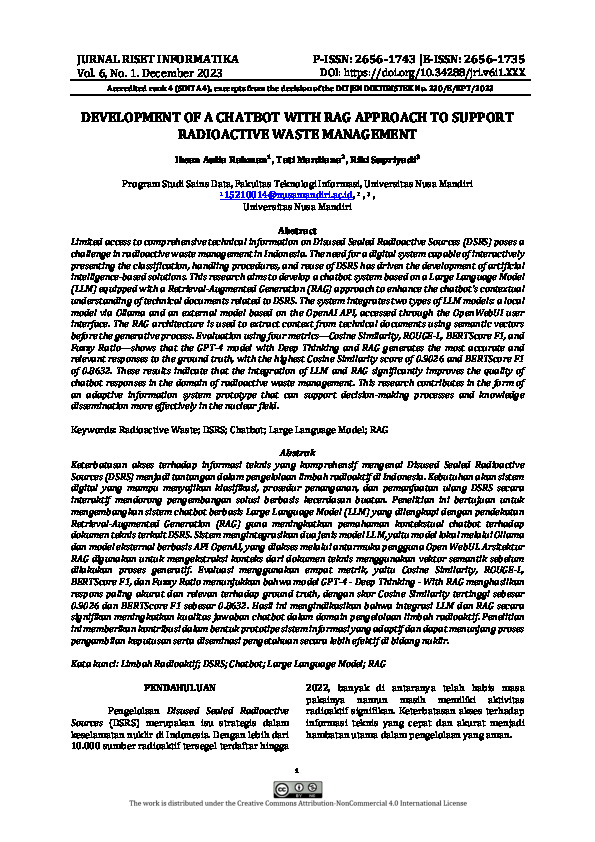
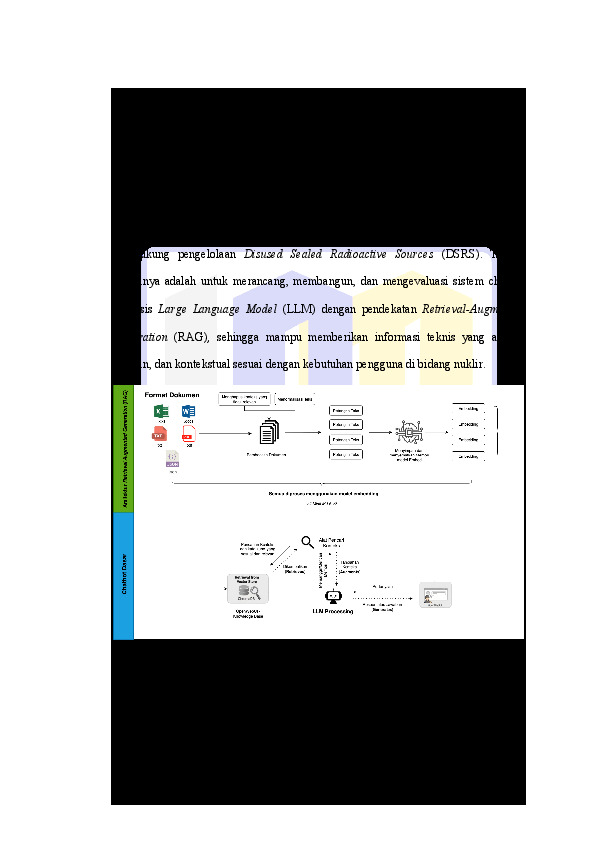
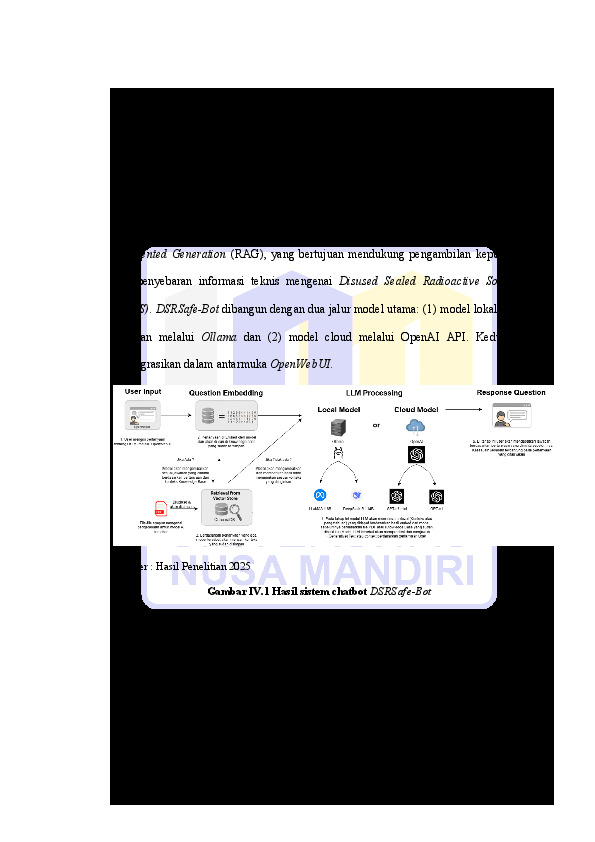
Keterbatasan akses terhadap informasi teknis yang komprehensif mengenai Disused Sealed Radioactive Sources (DSRS) menjadi tantangan dalam pengelolaan limbah radioaktif di Indonesia. Kebutuhan akan sistem digital yang mampu menyajikan klasifikasi, prosedur penanganan, dan pemanfaatan ulang DSRS secara interaktif mendorong pengembangan solusi berbasis kecerdasan buatan. Penelitian ini bertujuan untuk mengembangkan sistem chatbot berbasis Large Language Model (LLM) yang dilengkapi dengan pendekatan Retrieval-Augmented Generation (RAG) guna meningkatkan pemahaman kontekstual chatbot terhadap dokumen teknis terkait DSRS. Sistem mengintegrasikan dua jenis model LLM, yaitu model lokal melalui Ollama dan model eksternal berbasis API OpenAI, yang diakses melalui antarmuka pengguna OpenWebUI. Arsitektur RAG digunakan untuk mengekstraksi konteks dari dokumen teknis menggunakan vektor semantik sebelum dilakukan proses generatif. Evaluasi menggunakan empat metrik, yaitu Cosine Similarity, ROUGE-L, BERTScore F1, dan Fuzzy Ratio menunjukkan bahwa model GPT o1 - Deep Thinking - With RAG menghasilkan respons paling akurat dan relevan terhadap ground truth, dengan skor Cosine Similarity tertinggi sebesar 0.9026 dan BERTScore F1 sebesar 0.8632. Hasil ini mengindikasikan bahwa integrasi LLM dan RAG secara signifikan meningkatkan kualitas jawaban chatbot dalam domain pengelolaan limbah radioaktif. Penelitian ini memberikan kontribusi dalam bentuk prototipe sistem informasi yang adaptif dan dapat menunjang proses pengambilan keputusan serta diseminasi pengetahuan secara lebih efektif di bidang nuklir.
Unduhan
-

File_7 LAMPIRAN.pdf
Terakhir download 09 Oct 2026 02:10File_7 - LAMPIRAN
- diunduh 120x | Ukuran 1,148 KB
-

-

FULL TUGAS AKHIR_IHSAN AULIA RAHMAN - UPLOAD.pdf
Terakhir download 10 Oct 2026 12:10FULL TUGAS AKHIR_IHSAN AULIA RAHMAN - UPLOAD
- diunduh 7x | Ukuran 4,626 KB
-
Draft Paper TUGAS AKHIR - IHSAN.pdf
Terakhir download 10 Oct 2026 20:10File_8 - ARTIKEL
- diunduh 417x | Ukuran 273 KB
-

REFERENSI
[1] BAPETEN, “Data jumlah sumber radioaktif tersegel di Indonesia,” 2022.
[2] IAEA, “IAEA ANNUAL REPORT 2018 IAEA Annual Report 2018,” International Atomic Energy Agency, vol. 63, no. 5, pp. 27–198, 2018.
[3] J. H. Jurafsky, D., & Martin, Speech and Language Processing. 2023.
[4] OpenAI et al., “GPT-4 Technical Report,” vol. 4, pp. 1–100, 2024, [Online]. Available: http://arxiv.org/abs/2303.08774
[5] A. Grattafiori et al., “The Llama 3 Herd of Models,” pp. 1–92, 2024, [Online]. Available: http://arxiv.org/abs/2407.21783
[6] Y. Zhang et al., “Siren’s Song in the AI Ocean: A Survey on Hallucination in Large Language Models,” 2023, [Online]. Available: http://arxiv.org/abs/2309.01219
[7] R. Bommasani et al., “On the Opportunities and Risks of Foundation Models,” pp. 1–214, 2022, [Online]. Available: http://arxiv.org/abs/2108.07258
[8] P. Lewis et al., “Retrieval-augmented generation for knowledge-intensive NLP tasks,” Adv Neural Inf Process Syst, vol. 2020-Decem, 2020.
[9] International Atomic Energy Agency, “Artificial Intelligence for Accelerating Nuclear Applications, Science and Technology,” Artificial Intelligence for Accelerating Nuclear Applications, Science and Technology, pp. 1–98, 2022, [Online]. Available: https://www.iaea.org/publications/15198/artificial-intelligence-for-accelerating-nuclear-applications-science-and-technology
[10] V. Karpukhin et al., “Dense passage retrieval for open-domain question answering,” EMNLP 2020 - 2020 Conference on Empirical Methods in Natural Language Processing, Proceedings of the Conference, pp. 6769–6781, 2020, doi: 10.18653/v1/2020.emnlp-main.550.
[11] G. Izacard and E. Grave, “Leveraging passage retrieval with generative models for open domain question answering,” EACL 2021 - 16th Conference of the European Chapter of the Association for Computational Linguistics, Proceedings of the Conference, pp. 874–880, 2021, doi: 10.18653/v1/2021.eacl-main.74.
[12] W. E. Ojovan, M. I., & Lee, An Introduction to Nuclear Waste Immobilisation. 2014.
[13] Iaea, “GC(51)/5 - IAEA Annual Report 2006,” 2006.
[14] Jurafaky, “Chatbots and Dialogue Systems Introduction to Chatbots and Dialogue Systems Conversational Agents”.
[15] A. Casadei, S. Schlogl, and M. Bergmann, “Chatbots for Robotic Process Automation: Investigating Perceived Trust and User Satisfaction,” Proceedings of the 2022 IEEE International Conference on Human-Machine Systems, ICHMS 2022, 2022, doi: 10.1109/ICHMS56717.2022.9980826.
[16] R. R. Panigrahi et al., “AI Chatbot Adoption in SMEs for Sustainable Manufacturing Supply Chain Performance,” Sustainability (Switzerland), vol. 15, no. 18, 2023.
[17] X. Zhang, A. L. Chen, X. Piao, M. Yu, Y. Zhang, and L. Zhang, “Is AI chatbot recommendation convincing customer? An analytical response based on the elaboration likelihood model,” Acta Psychol (Amst), vol. 250, no. October, 2024, doi: 10.1016/j.actpsy.2024.104501.
[18] A. Kelly, E. Noctor, L. Ryan, and P. van de Ven, “The Effectiveness of a Custom AI Chatbot for Type 2 Diabetes Mellitus Health Literacy: Development and Evaluation Study,” J Med Internet Res, vol. 27, pp. 1–20, 2025, doi: 10.2196/70131.
[19] M. Ltifi, “Trust in the chatbot: a semi-human relationship,” Future Business Journal, vol. 9, no. 1, 2023, doi: 10.1186/s43093-023-00288-z.
[20] R. Nilsson and O. Rosman, “Design and Evaluation of a RAG Chatbot in an Industrial Setting,” 2025.
[21] F. Liu, Z. Kang, and X. Han, “Optimizing RAG Techniques for Automotive Industry PDF Chatbots: A Case Study with Locally Deployed Ollama ModelsOptimizing RAG Techniques Based on Locally Deployed Ollama ModelsA Case Study with Locally Deployed Ollama Models,” Proceedings of 2024 3rd International Conference on Artificial Intelligence and Intelligent Information Processing, AIIIP 2024, pp. 152–159, 2025, doi: 10.1145/3707292.3707358.
[22] Y. Goldberg, Neural Network Methods for Natural Language Processing. 2017.
[23] K. Mohiuddin et al., “Attention Is All You Need,” International Conference on Information and Knowledge Management, Proceedings, no. Nips, pp. 4752–4758, 2023, doi: 10.1145/3583780.3615497.
[24] J. Devlin, M. W. Chang, K. Lee, and K. Toutanova, “BERT: Pre-training of deep bidirectional transformers for language understanding,” NAACL HLT 2019 - 2019 Conference of the North American Chapter of the Association for Computational Linguistics: Human Language Technologies - Proceedings of the Conference, vol. 1, no. Mlm, pp. 4171–4186, 2019.
[25] T. B. Brown et al., “Language models are few-shot learners,” Adv Neural Inf Process Syst, vol. 2020-Decem, 2020.
[26] M. Thirunavukarasu, A. J., Jassar, S., Fote, G., & Ghassemi, “Large Language Models,” 2024.
[27] K. Gao, Y., Xiong, Y., Gao, L., & Liu, Retrieval-Augmented Generation for Large Language Models. 2024.
[28] N. Reimers and I. Gurevych, “Sentence-BERT: Sentence embeddings using siamese BERT-networks,” EMNLP-IJCNLP 2019 - 2019 Conference on Empirical Methods in Natural Language Processing and 9th International Joint Conference on Natural Language Processing, Proceedings of the Conference, pp. 3982–3992, 2019, doi: 10.18653/v1/d19-1410.
[29] Openwebui, “OpenWebUI Docs.”
[30] J. Ha, M. Kambe, and J. Pe, Data Mining: Concepts and Techniques. Elsevier, 2011. doi: 10.1016/C2009-0-61819-5.
[31] A. Shiri, “Introduction to Modern Information Retrieval (2nd edition),” Library Review, vol. 53, no. 9, pp. 462–463, 2004, doi: 10.1108/00242530410565256.
[32] C. Y. Lin, “Rouge: A package for automatic evaluation of summaries,” in Proceedings of the workshop on text summarization branches out (WAS 2004), Barcelona, Spain: Association for Computational Linguistics, Jul. 2004, pp. 25–26. [Online]. Available: papers2://publication/uuid/5DDA0BB8-E59F-44C1-88E6-2AD316DAEF85
[33] P. J. Rao, K. N. Rao, and S. Gokuruboyina, “An Experimental Study with Fuzzy-Wuzzy (Partial Ratio) for Identifying the Similarity between English and French Languages for Plagiarism Detection,” International Journal of Advanced Computer Science and Applications, vol. 13, no. 10, pp. 393–401, 2022, doi: 10.14569/IJACSA.2022.0131047.
[34] E. Laloy, B. Rogiers, A. Bielen, and S. Boden, “Bayesian inference of 1D activity profiles from segmented gamma scanning of a heterogeneous radioactive waste drum,” Applied Radiation and Isotopes, vol. 175, no. May, p. 109803, 2021, doi: 10.1016/j.apradiso.2021.109803.
[35] D. S. Wisnubroto, H. Zamroni, R. Sumarbagiono, and G. Nurliati, “Challenges of implementing the policy and strategy for management of radioactive waste and nuclear spent fuel in Indonesia,” Nuclear Engineering and Technology, vol. 53, no. 2, pp. 549–561, 2021, doi: 10.1016/j.net.2020.07.005.
[36] IAEA, Management of Naturally Occurring Radioactive Material (NORM) in Industry, no. October. 2022. [Online]. Available: https://www-pub.iaea.org/MTCD/Publications/PDF/PUB1998_web.pdf
[37] C. Potts et al., “A Multilingual Digital Mental Health and Well-Being Chatbot (ChatPal): Pre-Post Multicenter Intervention Study,” J Med Internet Res, vol. 25, 2023, doi: 10.2196/43051.
[38] S. Karkosz, R. Szymański, K. Sanna, and J. Michałowski, “Effectiveness of a Web-based and Mobile Therapy Chatbot on Anxiety and Depressive Symptoms in Subclinical Young Adults: Randomized Controlled Trial,” JMIR Form Res, vol. 8, 2024, doi: 10.2196/47960.
[39] Y. Ding and M. Najaf, “Interactivity, humanness, and trust: a psychological approach to AI chatbot adoption in e-commerce,” BMC Psychol, vol. 12, no. 1, 2024, doi: 10.1186/s40359-024-02083-z.
[40] X. Cheng, Y. Bao, A. Zarifis, W. Gong, and J. Mou, “Exploring consumers’ response to text-based chatbots in e-commerce: the moderating role of task complexity and chatbot disclosure,” Internet Research, vol. 32, no. 2, pp. 496–517, 2022, doi: 10.1108/INTR-08-2020-0460.
[41] H. K. L. Chau, T. T. A. Ngo, C. T. Bui, and N. P. N. Tran, “Human-AI interaction in E-Commerce: The impact of AI-powered customer service on user experience and decision-making,” Computers in Human Behavior Reports, vol. 19, no. June, p. 100725, 2025, doi: 10.1016/j.chbr.2025.100725.
[42] P. Berger and J. von Garrel, “How to design a value-based Chatbot for the manufacturing industry: An empirical study of an internal assistance for employees,” KI - Kunstliche Intelligenz, vol. 37, no. 2–4, pp. 203–211, 2023, doi: 10.1007/s13218-023-00817-6.
[43] M. Orden-Mejía, M. Carvache-Franco, A. Huertas, O. Carvache-Franco, and W. Carvache-Franco, “Analysing how AI-powered chatbots influence destination decisions,” PLoS One, vol. 20, no. 3 March, pp. 1–20, 2025, doi: 10.1371/journal.pone.0319463.
[44] I. A. Rahman et al., “Integration of machine learning models for enhancing radioactive waste management of disused sealed radioactive sources,” Nuclear Engineering and Design, vol. 442, no. July, p. 114272, 2025, doi: 10.1016/j.nucengdes.2025.114272.
[45] S. Syaiful Bachri Mustamin, Muhammad Atnang, Data Science untuk Pemula: Menaklukkan Tantangan dan Peluang di Era Big Data. Kendari: CV. Science Tech Group, 2024.
[46] Dr. D. R. Wijaya, Dasar Data Science: Dari Teori Ke Praktik. Sleman: Deepublish, 2024.
[47] A. A. Khan, M. T. Hasan, K. K. Kemell, J. Rasku, and P. Abrahamsson, “Developing Retrieval Augmented Generation (RAG) based LLM Systems from PDFs: An Experience Report,” pp. 1–36, 2024, [Online]. Available: http://arxiv.org/abs/2410.15944
Kiriman Terbaru
-

10 Oct 2026
-

08 Oct 2026
-

06 Oct 2026
-

05 Oct 2026
-

05 Oct 2026